Episode Transcript
[00:00:01] Speaker A: Well, welcome to the Truth Exchange podcast. This is the unique program where we have conversations about worldview all through the lens of oneism and two ism. This lens is based on Romans 1:25. We have exchanged the truth of God for the lie and worship and serve creation rather than the Creator who is blessed forever.
[00:00:21] Speaker B: Amen.
[00:00:23] Speaker A: I'm your host, Joshua Gilo, and with me, as always, is my good friend and co host, Mary Weller. Mary, it's good to have you with us again.
[00:00:31] Speaker C: Good to see you, Joshua. Thank you.
[00:00:33] Speaker A: This is a bit of a special episode for me personally. I was thinking back. You know, we have been podcasting as a ministry for over 10 years now.
[00:00:43] Speaker C: Wow.
[00:00:43] Speaker A: I remember when we first began at the suggestion of one of the deacons from New Life Presbyterian Church who runs this social media examiner that we should get into podcasting. We were all huddled up in our little office on Juniper street with Dr. Peter Jones in one of the orange 70s villa type chairs. And we are all huddled in there together, sharing on shared microphones.
And here we are doing a podcast again with our founders. I'm excited about today's episode because we're with the founder of truth exchange himself, Dr. Peter Jones, who is also the executive director, our fearless leader, Dr. Jones, welcome.
[00:01:28] Speaker B: Thank you.
[00:01:28] Speaker C: A little bit of inside baseball is that we all refer to Dr. Jones as FL Fearless Leader. He says it's fearful leader.
We interchange it. But I don't think I've written an email to you in probably five years where I haven't addressed you as FL because that's who.
[00:01:49] Speaker A: Well, he is not only our fl, but he's also been our teacher, our mentor. He's been a father figure to me in the faith.
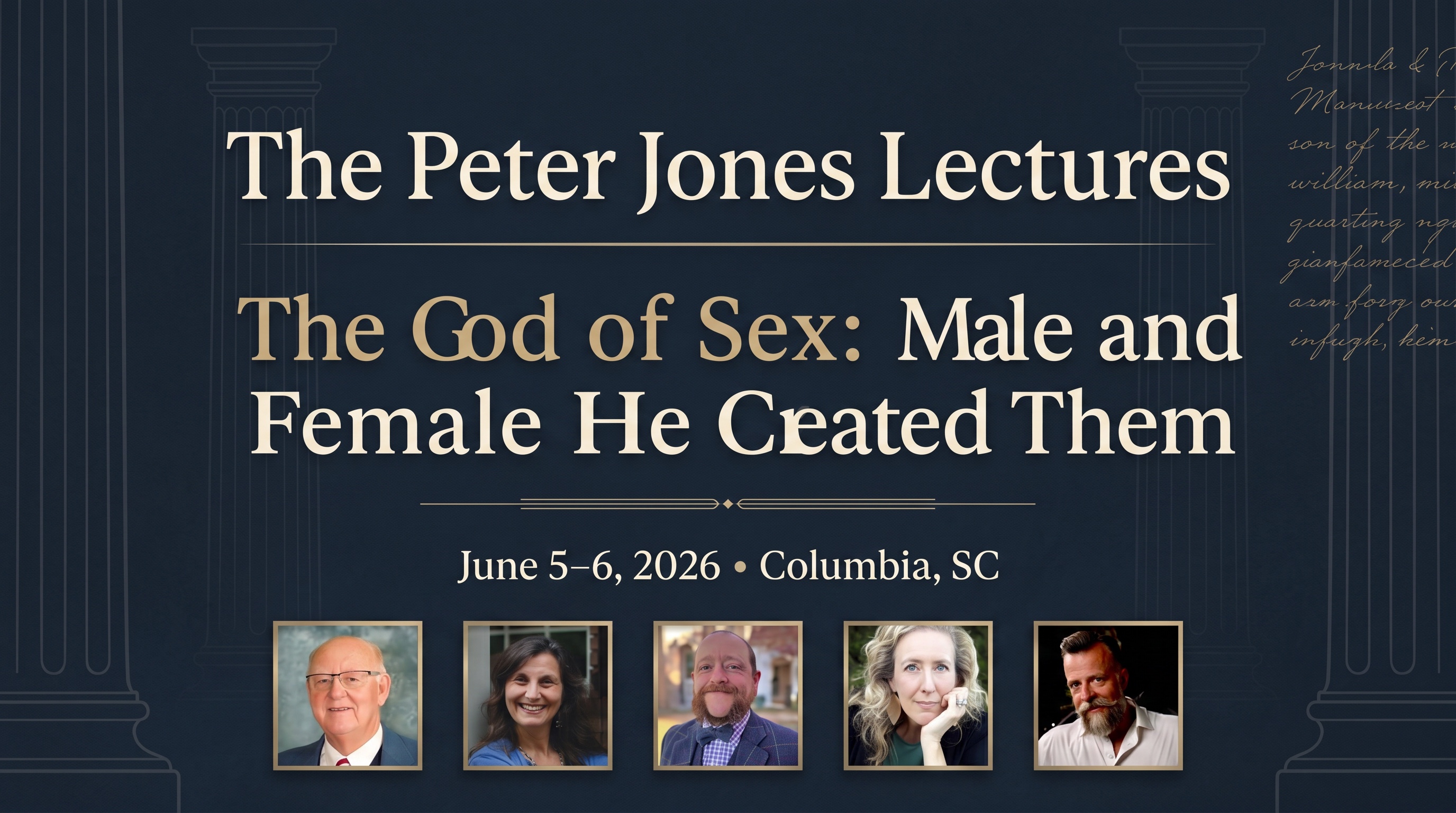
But he's also one of our keynote speakers for our upcoming inaugural Peter Jones Lectures, which is this week, June 5th through the 6th, here in Columbia, South Carolina. And the theme of this event is the God of sex, male and female. He created them. And in this conversation, we'll be previewing Dr. Jones's upcoming talk where he's going to explore really that vital question, how useful is theology when discussing sexuality? And so, at a first glance, many may think that God and sex are miles apart, but as we'll discover, they're actually quite intimately connected. So, Dr. Jones, again, it is truly an honor to have you on our podcast as we begin discussing about this before we, rather we began discussing about this just to highlight on some of the previous episodes we've had already. Mary Weller, you have have been our, quote, unquote, Guest, because you will be addressing the subject of transgender. I almost said transhumanism. That's for another discussion. But you'll be discussing transgenderism. We have had our friend, Dr. Rosaria Butterfield, who will be discussing festival feminism.
And then we have had recently also, just this past week, Pastor Josh Smith, who is my pastor, and he will be discussing the issue of a biblical man and engaging with the issue of toxic masculinity.
[00:03:33] Speaker C: And I just want to put out that after each episode, the one with Rosaria and the one with Reverend Josh Smith, I got text messages from friends who had the podcast, you know, come through for them. And I got a number of messages from people this time around who just really appreciated those episodes and loved those conversations. So thank you.
[00:03:57] Speaker A: Yeah, I, too, received quite a lot of feedback, and even from people who I didn't even realize or whom I did not realize listen to, the podcast, wrote in and said, that was a fantastic episode, and thank you for doing that.
So as we talk about today on the issue of sexuality, I think we're going to get into the issue that sexuality is never morally neutral and every sexual expression either glorifies God or worships creation and how biblical categories of difference in image are rooted in Genesis 1. Dr. Jones, I don't want to take the limelight from your talk, and I would love for you to let our listeners know. What exactly is the theme of your talk and what will you be exploring?
[00:04:51] Speaker B: Well, I'll be exploring the relationship between homosexuality and what we call oneism.
And oneism, of course, is the belief that everything is the same. There is no ultimate difference of anything. And in particular, there is no God who is distinct from us. Use the term tuism, because we're trying to recognize that there are different things. God placed them in the universe for the reason that we will understand how different he is.
And so twoism allows us to honor both the nature of creation as God put it together with a whole lot of distinctive things, including, in particular, sexuality and how God is distinct from us. And those are the two essential things we need to focus on. And that's what I do in my talk. I try to show how sexuality is a way of showing how God is distinct from the rest of the world.
It's a symbolism where we actually engage in activity which is deep and profound, namely sexuality.
And we show that we understand distinction.
And in doing that, then we recognize that God is distinct from us as well.
So that's the goal of my talk. And the other thing I do in my talk is to show that paganism is the belief in one ism, that everything is the same and there are no ultimate distinctions.
And I also show in my talk how in the ancient world we had priests who were homosexuals, who practiced homosexuality to show that there was no ultimate God.
There was the God of everything.
And so this is not new.
This comes from 2000 BC.
And so it's important to realize that we're not just inventing here, that there is a way of looking at life that goes all the way back 2000 years, pre Christ.
We need to see that what we do today has an effect upon how
[00:07:31] Speaker A: we believe that really does run contradicts the culture or the standard of today.
My body, my rights, what I want to do with myself. Sexuality is nobody else's business.
But you're actually saying that. No, what we do with our bodies and whom we love does matter because it's a reflection of our view of the world and our view of God.
[00:07:58] Speaker B: So we have to make a serious distinction between everything and between who we love, whom we love.
And we can only love sexually beings that are distinct from us, like males and females.
[00:08:16] Speaker C: It's interesting to me too, that love with that creational distinction is the only love that's productive.
[00:08:25] Speaker B: That's right.
That's the reason why it exists, actually. In order that Adam and Eve produced a system of life, namely produced children, and the children occupied the universe as God intended it.
So that's the future of existence.
[00:08:50] Speaker C: Yeah.
You deal in terms of sexual desire, and then I've ended up dealing so much with sexual identity.
In other words, can men become women and vice versa, or is there something in between?
But I'm just aware of how literally barren that entire idea is, because the medicines that are used from the youngest age to try to allow children to change sexes sterilizes them.
Men and women who are seeking to become the opposite literally do so by being. By having their protective organs removed or mutilated.
And even as they leave it, one of the tragic things is that there are men and women who have seen truth and actually found and now worship the Creator God. But they have to deal with the fact that this other ideology, this pagan ideology, has robbed of them that aspect of who they are as male and female. They can no longer reproduce.
[00:09:53] Speaker B: And quite naturally, of course, we need to make this point for people who are not believers, is that this is the secret of civilization, human civilization.
There is human civilization without the distinction of male and female.
[00:10:11] Speaker A: Yeah. One of the things that we discuss on the podcast with Pastor Josh Smith is that it's. Understanding that distinction between male and female is key to understanding how civilizations are actually made. Your teaching, Dr. Jones, is the biblical worldview lens of 1 ISM. And 2 ISM, as we mentioned, is based on Romans 1:25. How does that framework help us understand the current sexual revolution more clearly that we're experiencing today, and even that connected to that of in the 1960s?
[00:10:45] Speaker B: Well, it's very interesting.
Paul says we worship and serve creation rather than the Creator who is blessed forever. And Paul wants us to make a distinction between the creation and the creator. And then he says for this reason, and he goes into describing homosexuality in Romans 1:26. And so there's no question that Paul intended for us to think of sexuality and as part of how we see God being worshiped in creation. We worship him because he made us the way we are and we recognize and value the way he made us as distinct between male and female.
[00:11:34] Speaker A: Is the Apostle Paul, when he goes into for this reason through that whole list, is that at random, do you think? Or was Paul, the Apostle Paul trying to set something up and really help us see a structure for what's taken place? For this reason, God gives them over.
[00:11:55] Speaker B: Yeah.
Well, let's get the passage, because I will.
For this reason, God gave them up two dishonorable passions for their women, exchanged natural relations for those that are contrary to nature. And men likewise gave up natural relations with women and were consumed with passion for one another, men committing shameless acts with men and receiving in themselves the due penalty for their error. Paul is very clear here. I think he knows that this is what's happening in the Roman Empire. Sexuality is widely practiced. And he's showing that this comes from a wrong view of God. And I think we can make that affirmation about sexuality as we need to show who God is by recognizing how God has made. Made us a sexual being.
[00:13:00] Speaker A: Yes, you mentioned that Roman culture was. Was very sexualized. And that's not very. Not too different than from what we experience today.
We're not in a different era really than what the Apostle Paul experienced, that we as Christians should not shy away from being able to speak boldly against this worship of creation, which I think that that's where you'll be going with your talk and as you mentioned, is that the connection between homosexuality is actually a worship of creation or a reflection of that rather than the Creator who is. Who is blessed forever.
The second thing that you're talking about in your lecture, Dr. Jones, is image and human beings, male and female. Are made in God's image. What does it mean for our sexuality to reflect the very essence of God?
[00:13:52] Speaker B: That's a good question. We have the revelation of God as Trinity, and Trinity is the expression of both unity and distinction.
The three beings of. Of God are distinct, and yet they are profoundly unified.
And so in our sexuality, we express distinction and unity. So I think we need to realize that in living this particular way, we are showing who God is in his being. The scripture says God did this to show his image of himself. And that's the image that we show, that God is both human, one, and yet distinct.
It's interesting. In those ancient pagan worship systems, they wanted to get rid of distinction and they wanted to find the original unity.
So homosexuality was trying to show the original unity of things, not the distinction of things, and therefore not God as distinct from creation. But the Bible wants to show God as distinct, as different than us. And the distinction is a valid element in what and how he made things.
[00:15:14] Speaker C: When you refer to the ancient religions, Dr. Jones, and it's funny because I just looked at you as you were talking, and I see the book I'm about to refer to right over your shoulder. But you had given me a copy of American Veda, I think, all the way back in maybe 2010 or 2011, to read, and we were talking about the term advaita.
And advaita is a statement of Hindus, the Hindu version of truth. And people translate it as all is one, but what it actually means is all is not two.
So inherent in the statement that is their essential belief is a rejection of what God has shown to be true.
[00:15:57] Speaker B: That's right.
[00:15:57] Speaker C: And so I find it interesting, and Pamela Frost has pointed out, for instance, that when you see the images of Hindu gods and they have multiple arms, it's because on. It's depicting that on the front there is a maleness, but there's an alternate female depiction of the same God in another form on the backside. So there's this merging of the opposites. And so that whole.
It's like they can't get away from the binary because the only statement of faith that they can. They can start with is a rejection of the binary, which inherently acknowledges that there is a binary that they're trying to get away from. I just. I don't mean to be inflammatory in saying that, but it's just really interesting to me that that's where they have to start.
[00:16:45] Speaker B: And that author you mentioned, what was his name?
[00:16:48] Speaker C: Philip Goldberg.
[00:16:48] Speaker B: Philip Goldberg. He says that Advaita has. Is becoming the very essence of what people believe in our present day.
So it's funny that what we saw in Romans 1:25 is actually being played out in our own lives and in our culture as not two.
And people say they are not two, they are only one. There is not really distinction, so that that is coming out in the way people describe their own sexuality. And it's very interesting that the scripture is right on course in affirming that as a matter of fact, sexuality is two, not one. And you cannot affirm divinity with two men having sex together, because what you're doing is affirming one ism. And so that will not speak about God. But if we practice heterosexuality, hetero means other, then we are in the deepest sense of our being, affirming distinction and the fact that God is distinct both in himself, but also in terms of his relationship with the world itself, creation.
[00:18:26] Speaker A: You mentioned that homosexuality and transgenderism function as a oneist sexuality.
Could you explain how that they ultimately witnessed to it a different God? And I would like to see if you could tailor that response to those who are Christians or those who are claiming Christ and embracing that homosexuality is a part of their spirituality that glorifies God.
[00:18:56] Speaker B: Well, that's the point.
It does not reflect how God created the world.
Thus it does not give to people a notion of what is true.
God has created the world with distinctive things in it and in particular sexuality.
And so if we don't recognize that, we have failed to recognize the Creator and how he made the world and how he made us and how he made sexuality.
So we cannot be Christians and practice one ism.
[00:19:34] Speaker A: It seems like every 10 years there's a movement within Christendom of. Of like the emergent church, leaving the church, walking out, detransitioning from Christianity.
There's a D word I'm thinking of. I can't think of what it is. Mary, if you remember or know what I'm talking about, but deconstructionism, you're welcome. Thank you. Where those who are walking away from the faith and some even claiming that they're not being apostate, they're still embracing Jesus and they are. Part of the reason why they are leaving the church in droves is because they felt that the church thought too much about sexuality.
And the mantra or the rant is that sexuality is actually a secondary issue.
And a lot of younger generations are starting to embrace that ethos, that sexuality should not be on the main front. It really doesn't matter. Why do you believe, Dr. Jones, that what the church needs today is a robust theology of sexuality. That is essential.
[00:20:46] Speaker B: Well, I risk repeating myself here. The fact that God created us as distinct beings, male and female, he had a reason to think do that, wanted to show us that distinction is a good thing, because we have to make a distinction between us and God himself.
He is distinct from everything in creation as the Creator.
And we will lose that fundamental distinction if we don't follow his laws in making us as distinct beings, who every time we have relationships with other human beings, have to recognize male and female distinction, why it's so fundamental to us. Funny enough, the very sexuality of us as human beings takes us to who God is himself.
[00:21:48] Speaker C: Do you make much, Dr. Jones, of the fact that, you know, God creates male and female in his image?
Then they are tempted by Satan, who tells them, you can be like God if you eat from the knowledge, the tree of the knowledge of good and evil. And when they have eaten, of course they can't be like God because they are created. They will never be uncreated. But immediately the, the curse, the ray of hope in the curse is that Eve will bear a child, and through her, her seed, the one will come, will crush the serpent. But even in the way that it's structured, it says that her desire will be for her husband, almost like it will be for his place to have his role, but that his beautiful role is to oppress her. Like it seems to me, even the curses were gender based curses because they had everything to do with.
So the undoing of humanity had to do with the way that they relate to each other as male and female starts to come apart. And therefore their ability to see and understand God and obey God is also very, very fractured. Do you have any thoughts about that? I told you, I've been in Genesis a lot recently, so I've been thinking about that a lot.
[00:23:10] Speaker B: Well, I find it just interesting that in Genesis you do have that distinction between males and females. It is a fundamental starting point of how we understand what God has done in creating human beings.
And if we reject what God has done, then we reject God's creative work and we limit our ability to know God. As a matter of fact, it's funny, but how sexuality is profoundly interested in proposing the nature of God himself.
No one sees this. You know, it's just, let's have sex.
Who?
Yeah, but God cares because he made us with the way we are.
[00:24:05] Speaker A: That sounds like there is a gospel message in there.
In your talk, God cares. And your talk will give a sharp analysis of what is happening in the culture. How we got here.
What is then that gospel offering a part of your lecture? What is the good news that people can look forward to hearing at the conclusion of this event?
[00:24:36] Speaker B: I'm not understanding your question.
[00:24:39] Speaker A: Is there a gospel offering in the message of twoism and sexuality?
[00:24:45] Speaker B: There is a gospel message of the affirmation of God as creator who loves his creation and wants the creation to function the way he determined it should.
That sounds like law, but it's also love because God loves us and wants us to function well.
So I think we can find the gospel in that.
[00:25:12] Speaker A: What. What hope of the gospel offer is to those who have embraced androgyny or androgynous sexualities and those who are struggling with a gender blur?
[00:25:26] Speaker B: Well, they need to face what the scriptures are saying and find the liberty that comes from finding what is true about us as human beings and not buy into the false view of sexuality which is taking over today.
I think we feel fail to see who God is once we accept transgenderism.
[00:26:03] Speaker C: It's like we're also offering people and speaking to them in biblical terms about who they are and who God is.
They're offering the only, well, the only truth one, but the only way to live that does not require. Require you to give up essential parts of yourself.
In words, every other path that you choose requires you to reject some good thing that God created for you and for your flourishing.
And it seems that I have felt this way and I've heard Rosaria express this too, that in asking men and women who are in same sex relationships to be give up those relationships so that they might begin to pursue righteousness in the way that they live their lives.
That we are asking them to be forever lonely. That we are asking them this tragic thing to give up something that is so precious to them. And I remember Rosario sharing. I think the first time I heard about this was at the first conference we did with Rosaria in 2020 in South Carolina.
Yes, Rosaria shared about two dear sisters she knows who had been confronted with that question. They had been living in a same sex lesbian relationship. And I believe they even had adopted children. I would, I would need to double check that. But that when they became Christians, first one and then the other, they did have to separate from that part of their relationship. And what they recognized was that in loving each other as sisters in Christ Christ, there was a fullness in the way that they loved each other because it was not sexual. That was so much more whole and life giving to them simply in friendship and sisterhood that they didn't feel that they had really been asked to give up anything at all in not having the lesbian relationship any longer. In other words, when women and women interact with each other, it's a beautiful thing. Thing. We can relate to each other, we can love one another, we can be vulnerable with each other in a way that we can't necessarily with men. We can't be understood the same way. But when you add sex into ruins the beauty of that, it ruins the protectiveness of that. And I would assume that there is something similar going on with men, though I am not a man, so I do not know. But I'm assuming, you know, that there's something in brotherhood and the way just watching the way that my. My sons and their buddies just kind of bro out, you know, it's very different. And that requires that there not be sex involved for that to last and to flourish as well.
[00:28:52] Speaker B: I think she said what was important to be said. She was also saying what Rosaria said, of course, which came from experience.
He was a lesbian and she found freedom when she walked out of that.
[00:29:10] Speaker A: As we begin to wrap up this podcast, Dr. Jones, is there anything that or is there something that in particular that you are looking forward to as we gather together this coming weekend?
[00:29:25] Speaker B: What are the donuts going to be like?
[00:29:29] Speaker C: I ordered you short ribs for dinner one night and I was going to pair it with a French red. But you're looking forward to the donuts?
[00:29:38] Speaker A: There will, unfortunately. I always think about that one. That one line that you and John Lennon would say, Whatever happened to that crispy bacon? There won't be any crispy bacon.
[00:29:49] Speaker B: You remember that, huh?
We always said that whatever happens to
[00:29:54] Speaker C: the crispy bacon, Joshua, what I'm looking forward to.
[00:29:59] Speaker A: What am I looking forward to? Did you ask that?
[00:30:02] Speaker C: No, you to ask me what I'm looking forward to.
[00:30:04] Speaker A: Oh, I don't really care, Mary.
What are you looking forward to, Mary?
[00:30:11] Speaker C: The BUC EE's.
[00:30:12] Speaker A: The BUC EE's.
Of course you are. Of course you are.
[00:30:17] Speaker C: I am looking forward to. And I talked about this in another episode already, but I really am. And I think you will agree with this, Dr. Jones. The beautiful fellowship that comes from these live events, our think tanks every year when we used to do them in Escondido in the past were such a beautiful times of fellowship. Talking to like minded believers, learning from each other, thinking deeply about things. The conversations never ended. At the end of the talks, they continued on into the panel discussions and the coffee time over. Donuts and over.
Over meals that we had together.
And I am very much looking forward to that time with all of you. This is our first family reunion in a number of years where we'll all be together this way.
And so I'm looking forward to that. And I'm looking forward to the new people who will come who have never gotten to participate in this with us before. And I'm so glad, Dr. Jones, that you're going to be there, you and Rebecca. It's just I'm anticipating a wonderful time.
[00:31:30] Speaker B: How can I not be there when you've called the series the Peter Jones thinking or something, whatever name.
I don't deserve that. But I think it was Rosario's idea, wasn't it, that she came up with that name? But I just feel honored by that and I just want to be there and participate.
[00:31:56] Speaker C: Well, you do deserve it, Dr. Jones, in that the Lord has done so much through you.
And as Rosaria and Joshua and I were talking about, I think it was prior to our recording the episode that we did with Rosaria two weeks ago. She. She's the first one who said it felt like a family reunion. She was giddy about it because we are your spiritual children.
You have by honoring with Rebecca, and Rebecca is such a huge part of that shaped each of our lives so profoundly.
I can't comprehend what my life would look like had I not gotten hired in 2008, had you not kindly overlooked the Obama sticker on the back of my car and all of my woke about things that you taught me and you corrected me and you asked me why I thought the things that I did.
You were very much a seminary professor to me and to Joshua and to Rosaria and therefore, yes, very much a spiritual father. And so these are the inaugural Peter Jones lectures, which means you have to come back next year.
[00:33:04] Speaker B: Well, I'm looking forward to being at these lectures too, because I'm sure that I'll discover people who lecture in them, finding things about what I said that I didn't realize what I was saying.
And I can hopefully find depth in what I was saying because people had thought deeply about what I was trying to say.
[00:33:35] Speaker C: It's as though there is a productive relationship when we try to look at God rightly. He keeps bringing up truth and truth and truth. There's no plumbing the depths of it.
[00:33:47] Speaker B: But I hope there'll be a lot of people there. I think that the lectures will be really valid because they are trying to bring out the essence of what the Apostle Paul was saying in Romans 1:25.
And that's just profound.
It's one ism and tuism.
It's the fact that God is different than us as the Creator. And that makes two ism.
And if we don't recognize God as distinct from us, we will fail to understand the meaning of existence.
[00:34:26] Speaker A: Excellent. Mary, do you want to close this out, please?
[00:34:29] Speaker C: Yes. So, Joshua, can you remind me, which two books are we giving as a gift to everyone who participates at the live event?
[00:34:36] Speaker A: If you register now before the date of the conference, you will receive two books. You will receive Rosaria Butterfield's latest book, Five Lies.
And see, actually I have a copy here on my desk. Five Lies of Our Anti Christian Age by Rosario Butterfield. You'll also receive a copy of Dr. Peter Jones book, the God of Sex. Of course, we will have the whole Truth Exchange library available for for your perusal and purchasing pleasures during the conference.
Of course, we also have various different resources that will be available for free. But please do register online. That way we can get a headcount for that. We have enough food to feed you. That's very important.
We will not turn you away from the door if you don't register before then. But please do register. It does help us have a head count account.
[00:35:36] Speaker C: Yeah, it absolutely does. And so you can go to truthexchange.com that's the word truth, the letter X, the word change.com and immediately right now you will see all of our bright shiny faces and you'll be able to click a button and register. And we really would encourage you to do that, to share it with your friends.
It seems like there are people who are finding out and registering just this week. And so we're excited about that. That and as always with the with the Truth Exchange podcast, wherever you listen to podcasts, please take the time to like and subscribe and leave comments that helps us beat the algorithm so that more people can get this content.
And we are looking forward to seeing some of you. I expect some of them will be South Carolina farmers. I've been promised South Carolina farmers are going to be attending, but we're looking forward to seeing all of you in Columbia, South Carolina this weekend. And after that, it's back to the podcast and we'll meet up with you next week.